Capture and qualify
Create leads and contacts from a sentence, an email, or a voice note. The agent enriches, deduplicates, and qualifies against your criteria before anything is saved.
Every relationship, commitment, and conversation your company runs on, in one place, ready for whoever picks up the account next. That is what a CRM is for. Why it so rarely delivers has nothing to do with the software: maintaining it is tedious, people change roles and companies, and the context leaves with them.
The CRM Agent turns maintenance into a conversation. Your team talks to the CRM in plain language, the agent does the structured work, asks about anything missing, and keeps every record clean enough for the next person to rely on.
Ask any team what their CRM is worth and the answer is the same: everything, when it is current. Ask them to keep it current and you get a sigh. Data entry competes with the actual job, so fields get skipped, notes stay in inboxes and heads, and the record drifts from reality. When someone leaves, their pipeline becomes a guessing game for whoever inherits it.
The CRM Agent removes the chore without removing the discipline. People work the way they already talk. “Log a call with Anna at Meridian, she wants pricing by Friday, move it to proposal.” The agent turns that into clean, structured records, checks for anything missing, and writes only once the entry meets the standard you set.
| CRM as a chore | CRM as a conversation |
|---|---|
| Reps retype what they just said into a dozen fields. | They say it once, in plain language, and the agent structures it. |
| Half-filled records: no phone, no next step, vague notes. | The agent will not save until the detail that matters is there. |
| Knowledge lives in inboxes and people’s heads. | Every commitment lands in the CRM as it is made. |
| A rep leaves and their pipeline becomes guesswork. | The record is complete enough for anyone to pick up. |
| Managers chase people to update deals. | Updating is one sentence, so it actually happens. |
Lead capture is where most CRM assistants stop. The CRM Agent covers the full range of processes a CRM runs, from first touch to closed business to the daily hygiene that keeps the data trustworthy.
Create leads and contacts from a sentence, an email, or a voice note. The agent enriches, deduplicates, and qualifies against your criteria before anything is saved.
Convert leads to opportunities, advance stages, update amounts and forecasts, and record why a deal was won or lost, all in natural language.
Log calls and meetings, set activities and reminders, and book the next step, with the agent resolving dates, owners, and conflicts for you.
Open and update cases, tie them to the right account, and keep the customer history complete long after the deal closes.
Merge duplicates, fill gaps, and standardise fields across the whole database, enforcing your rules on existing records, not just new ones.
Question the CRM in plain language and get answers grounded in your live data, so the pipeline review runs on facts instead of memory.
Each of these is a defined capability the agent understands from day one, and new ones are added to fit how your business actually runs.
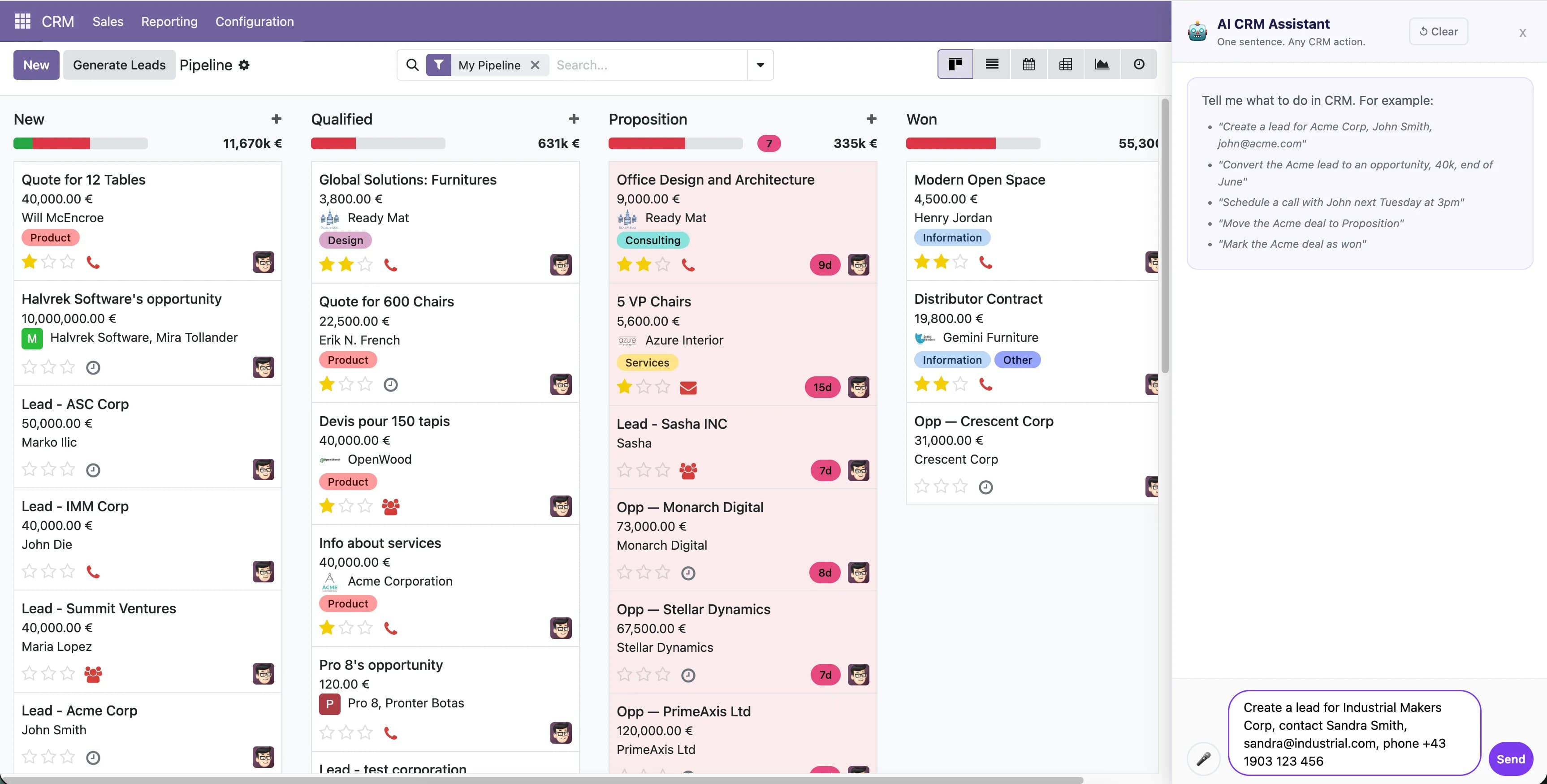
The CRM Agent inside Odoo, with a demo pipeline. Scroll through one conversation, from the first sentence to a won deal.
Step 1 of 8
Type what needs doing, the way you would say it. Company, contact, email and phone in one line.
Create a lead for Industrial Makers Corp, contact Sandra Smith, sandra@industrial.com, phone +43 1903 123 456
Step 2 of 8
Before anything is saved, the agent shows exactly what it will create. Nothing is written until someone confirms.
Step 3 of 8
Confirmed, and the lead is on the board in the right column, contact attached. One sentence replaced a form.
Step 4 of 8
Stage changes work the same way. Cancel a preview and nothing in the CRM changes.
Mark the Industrial Makers deal as Won
Step 5 of 8
A lead that looks like one you already have is flagged before it is created. You decide whether it really is new.
Add a new lead. Company name is Maker Industries. Contact is Sandra Smith, sandra@makers.com
Step 6 of 8
When it picks the wrong record, say so. It finds the right one and shows a new preview.
No, not that Makers. But the Maker Industries
Step 7 of 8
A call needs a number. With none on file, it asks for one, or lets you go on without it on purpose.
Make a call with Sandra in 2 days
Step 8 of 8
Mark a deal won in a sentence. The change lands in the record's history, with who made it and when.
Yeeeah we did it. We closed the deal with Halvrek
Most tools save whatever you type. The CRM Agent does the opposite. Before anything is written it checks the entry against the standard you have set, and when something is thin, ambiguous, or missing, it asks. A deal with no next step, a contact with no way to reach them, a note too vague to be useful next quarter: the agent catches it in the moment, while the context is still fresh, and works with the person until the record is genuinely good.
You decide how strict that standard is. Different teams, record types, and stages can carry different requirements, from a light nudge to a hard gate. The result is a database you can trust, built by the people closest to the work instead of cleaned up months later by someone who was not there.
Clean data, captured at the source, not scrubbed after the fact.
Speed on the way in, control over the outcome. Every action the agent proposes is shown in full before it touches your CRM, and nothing is written until someone confirms.
Every create, update, or stage change is presented for review first. Confirm to commit, correct or cancel if it is not right.
The agent proposes and a person decides. It handles the structured work and hands judgment back to your team.
Every action is attributable and logged, so any entry can be traced back to who approved it and when.
The agent acts within your existing CRM roles and access rules. It can never do anything the user could not already do.
The CRM Agent is model-agnostic. Run it on Mistral, Anthropic, or OpenAI, connect it to Microsoft Copilot, or point it at a model you host yourself. You are never tied to one vendor’s roadmap, pricing, or region.
For teams with strict data-residency or confidentiality rules, a self-hosted model means customer data never leaves your infrastructure. The same agent, the same capabilities, running entirely within your own walls.
Today the CRM Agent runs natively on Odoo CRM, embedded directly in the interface your team already uses. Support for Microsoft Dynamics 365 is in active development, bringing the same conversational layer to Dynamics pipelines.
The agent is built as a portable layer over the CRM rather than a fork of it. That is what lets the same capabilities move from one platform to the next, and how we extend to the CRM your business runs on.
Native, embedded in the Odoo interface your team already works in.
The same conversational layer, coming to Dynamics pipelines.
The portable design is built to extend. Tell us what you run.
No. It proposes and your team confirms. Every write is previewed and needs a human yes.
Whichever you choose: Mistral, Anthropic, OpenAI, Microsoft Copilot, or a model you host yourself.
Yes. With a self-hosted model, customer data never leaves your environment.
Odoo is supported today and Dynamics 365 is in active development. Tell us your setup and we will show you where it stands.
The agent only asks when something material is missing, at the moment of entry. You tune how strict that is per team, record type, and stage.
The fastest way to understand the CRM Agent is to watch it work on a CRM that looks like yours. Tell us what you run and how your team works today, and we will set up a demo.