Scattered data
Cases live in Excel sheets, legal case management software, email inboxes and paper files. There is no single source of truth.
Upload your cases, and the platform handles the rest: communication with authorities, vehicle holder data extraction, case matching, and fee collection letters. What took days per case now takes minutes. Legally verified and managed by our Austrian legal partners.
Create your account and process your first cases today. No sales call, no implementation project.
This is not a prototype. The platform was built from direct operational experience and runs production workloads today, processing data across thousands of authority responses and invoices.
Self-serve if you are ready to move today. A custom solution if your operation needs something the tiers below don't cover.
Pick a tier, pay per use, and go live today. Maintenance and updates are included, and you can move up a tier as your volume grows.
For operations that need something the self-serve tiers don't cover, whether that is bespoke authority integrations, unusual data formats, or a different commercial structure entirely.
The daily reality of collecting parking violation fees, in every operation that has not automated it.
Cases live in Excel sheets, legal case management software, email inboxes and paper files. There is no single source of truth.
Every vehicle holder information request to an authority is typed, formatted, printed, or hand-assembled into a PDF.
When authorities reply, someone reads each letter, finds the holder data, and retypes it into a spreadsheet. Often into several.
The process is not fully logged. When a case goes missing or a deadline slips, it is hard to trace what happened, when, or by whom.
Days or weeks pass between a response arriving and the holder data reaching fee collection. That is revenue sitting still.
Manual entry means forgotten cases, typos, mismatched cases and missed payments. The more volume grows, the worse it gets.
More cases means more people to process them. There is a hard ceiling on what a manual process can carry.
From case creation to collected fee, one connected workflow. You approve; the platform does the rest.
Cases arrive by file upload (CSV or Excel) or by direct API integration with your photographic evidence system. Duplicate detection and validation run automatically, and every case is logged from the moment it enters. Cases can be rejected against predefined criteria, such as emergency services, authority or diplomatic vehicles.
The platform generates official holder information request letters, correctly grouped, formatted, addressed and signed by the logged-in user. On your approval they are dispatched by email as PDF attachments, with delivery tracking and BCC confirmation built in.
When authorities reply, the extraction engine reads the documents and pulls the business-critical fields: holder name, address, licence plate, fee amounts and banking details. It validates each field and flags anything questionable. You see the extracted data next to the source document.
Authorities rarely reply in clean, structured formats. Extracted holder data is linked back to the original case automatically. Exact matches resolve instantly, ambiguous ones are flagged for a quick review with the full evidence on screen, and one response can link to several cases.
Financial data is reviewed and validated before any payment is triggered. Fees are grouped by authority, banking details (IBAN and BIC) are validated, and everything is prepared for SEPA-compliant transfer. Your finance staff approve each batch before it executes.
Collection letters go out to the vehicle holder. For unpaid fees the platform generates reminders with interest calculated to the exact day, plus VAT and totals due. Batch processing prevents duplicate reminders and tracks every letter sent.
The real application, with a demo organisation's data. Watch one case go through it.
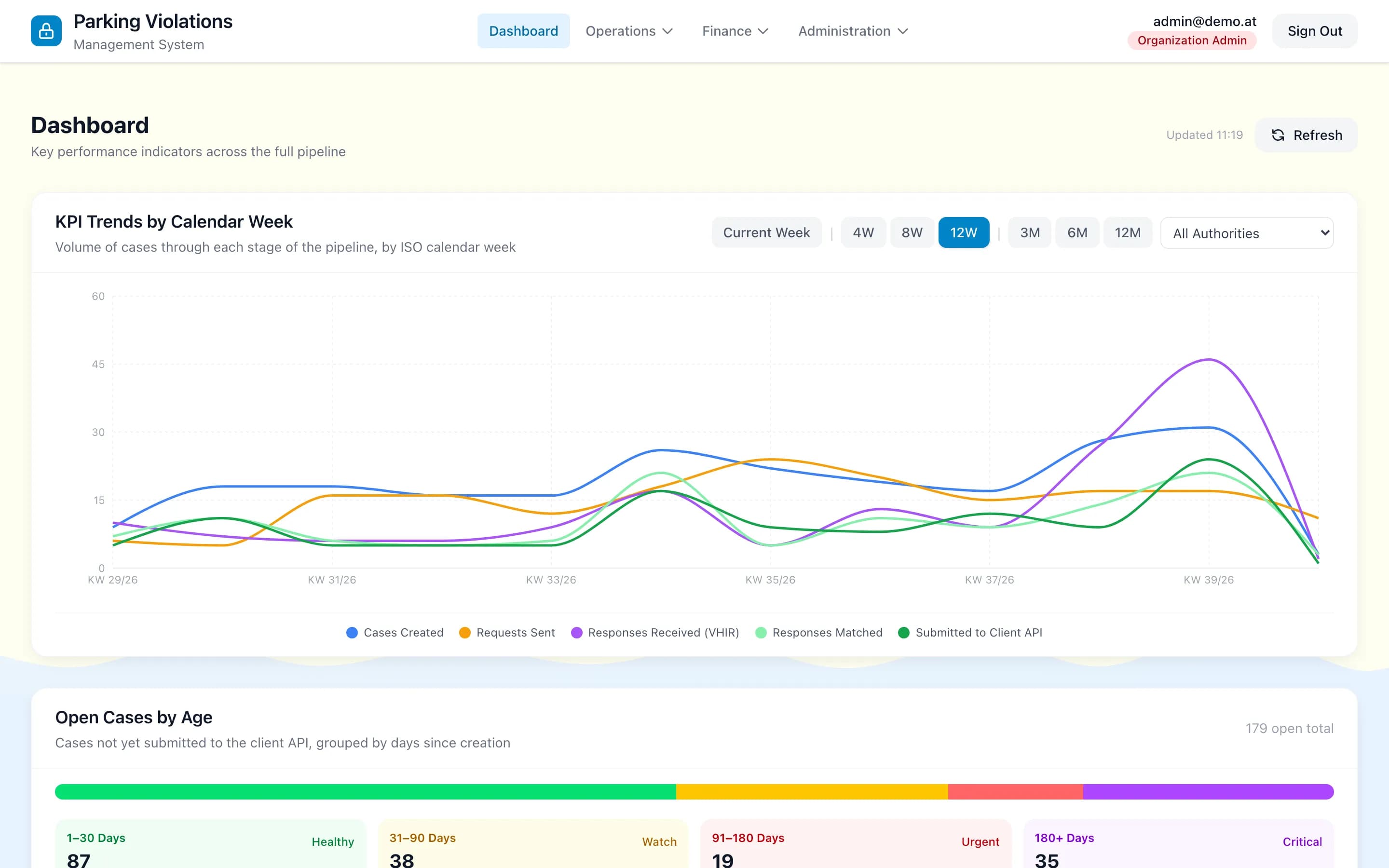
OverviewThe whole pipeline, week by week: cases created, requests sent, responses received and matched.
| Aspect | Current state | With the platform |
|---|---|---|
| Data | Scattered across Excel, case management software, sheets and email | One platform, one source of truth |
| Letter prep | Manual, one letter at a time | Automated generation and batch sending |
| Response reading | Staff process each authority letter by hand, slowly and expensively | Holder data extracted in seconds, more accurately and more cheaply |
| Case matching | Manual lookup, cross-referencing and tracking | Automatic matching with smart suggestions |
| Fee processing | Spreadsheet calculations and manual bank transfers | Validated SEPA exports, grouped by authority |
| Traceability | No audit trail, so things fall through the cracks | Full history on every case, every automatic and manual action logged |
| Error rate | Typos, mismatches, missed cases and missed deadlines at 80 to 90% accuracy | 99%+ accuracy, with validation checks and alerts |
| Scalability | More cases means more staff, more training and high churn on mind-numbing work | 10x the volume with the same team |
| Turnaround | Days to weeks per case cycle | Minutes, from response to collection letter |
| Reporting | Manual report building at month end | Real-time dashboard with KPIs and trends |
Vehicle holder information comes from the national registration authority. Here is where the platform operates today.
We send vehicle holder information requests directly to every registration authority in Austria, more than 100 in total. This is where the platform runs today, across every location you operate.
Vehicle holder information for Germany is retrieved through the Kraftfahrt-Bundesamt, the federal vehicle registry. We do not integrate with individual state or municipal authorities in Germany.
The Netherlands is a prospective next market, added if there is demand. Operating somewhere else in Europe? Ask us.
Self-serve, in the order you would actually do it.
Pick a tier and sign up on the platform. No procurement cycle, no implementation project.
Configure the authorities you work with and put your own letterhead on generated correspondence.
Upload a CSV or Excel file to start immediately, or connect your photographic evidence system by API.
Review the generated authority requests, approve, and they are dispatched. From there the workflow runs itself.
Professional includes a guided path: we map your current workflows and authority landscape, adapt the platform to your stakeholder structure and data formats, train your operations and finance teams on your real data, then run a controlled pilot before full go-live.
A monthly platform fee plus a price per processed case. The more you process, the lower both get. Change tier or cancel monthly.
Start on one site and see the numbers for yourself.
From€500 per month
For operators running violations across a growing portfolio.
From€1,000 per month
Highest volumes, lowest per-case rates, a named contact.
From€1,500 per month
Vehicle Holder Information Authority fees are not included and are charged at cost, exactly as invoiced by the authority. All prices exclude VAT. Indicative pricing, not a binding offer. Your commercial terms are fixed in writing before anything starts.
No. Pick a tier, create your account, and upload your first cases. A demo is available if you want one, but nothing is gated behind it.
Registration authorities charge their own fee for releasing vehicle holder information. Those fees vary by authority and change independently of us, so we pass them through at cost, exactly as invoiced. Nothing is added on top.
Austria is our primary market: we integrate directly with every registration authority in the country, more than 100 in total. Germany is our second market, covered through the federal KBA registry; we do not integrate with individual state or municipal authorities there. The Netherlands is a prospective next market if there is demand, and we're happy to scope any other European market on request.
That is the point of it. Authorities rarely reply in clean, structured formats. The extraction engine pulls the fields, validates them, and flags anything ambiguous for a quick human review, with the source document alongside.
You do. Financial data is reviewed and validated, fees are grouped by authority and prepared as SEPA-compliant batches, but your finance staff give the final approval before any transfer executes.
Every action in the system, automatic or manual, is logged and traceable. Every case carries its full history. There are no loose ends.
Yes. Tiers are monthly. Move up as your volume grows and the per-case rates drop with you.
Create your account and run your first batch. If you would rather see it working on your own data first, ask for a demo.
Tell us roughly what you process and we will show you the workflow on data that looks like yours.